One-on-one ACT tutoring for Reading
The cool thing about ACT reading comprehension is that we can often make a lot of progress in a short amount of time; the section is largely strategy based. With that said, students with poor reading comprehension will need much more work than those who are good at reading literature and adult-level non-fiction.
The missing link to significant improvement is often conversation - though of course there are plenty of videos online about ACT reading strategies, being able to talk through the nuances of a particular question with a veteran ACT tutor can go a long way toward confidence: why is this choice wrong, exactly? Where's the proof that this choice is right? Our ACT tutor Blake Jensen has been doing this for many years and is happy to help!
Blake works with students one-on-one, at our Carmel Valley office in San Diego or anywhere on Zoom. Sessions are built around the current ACT Reading section, which changed in 2025: 36 questions in 40 minutes, with shorter passages than the old test.
We also offer ACT English, Math, and Science tutoring - and most of our clients work with us on the entire ACT.
Check out our Google Reviews here!
What’s on the ACT Reading section
ACT Reading is an evidence test.
ACT is basically asking: can you read a passage quickly, keep the structure in your head, and prove your answers using the text?
A few things to know:
-
Reading is 40 minutes for 36 questions, or about 67 seconds per question. That is the enhanced ACT, used for national online tests since April 2025 and national paper tests since September 2025. We wrote about the change in The ACT Slims Down.
-
You’ll see several passages. Some sets are one longer passage, and some are two shorter passages, where a few questions ask about both.
-
Since 2021, one reading passage may include a graph/table/figure and some questions ask you to integrate that visual info with the text.
-
Only 27 of the 36 questions count. The other 9 are unscored field test questions, and ACT doesn’t label them, so every question has to be treated as if it counts.
-
Reading now carries more weight. The Composite score is the average of English, Math and Reading. Science is optional and no longer part of the Composite.
Old vs. current ACT Reading:
| Old ACT Reading | Current ACT Reading | |
|---|---|---|
| Time | 35 minutes | 40 minutes |
| Questions | 40 | 36 (27 scored) |
| Time per question | about 53 seconds | about 67 seconds |
| Passages | Longer | Shorter |
| Counts toward the Composite | One of four sections | One of three sections |
What ACT says it’s testing:
-
Key ideas & details (44 to 52% of the section): main point, purpose, evidence questions.
-
Craft & structure (26 to 33%): why the author used that word, that sentence, that paragraph order; what a phrase means in context.
-
Integration (19 to 26%): comparing parts of a passage, comparing two passages, or combining text and a graphic.
How we teach ACT Reading
In tutoring, we focus on four things:
-
Evidence discipline
If you can’t point to the line(s) that prove an answer, you’re guessing. We train students to stop “vibe picking.” -
Passage mapping
We teach a quick way to track: main point, shifts, and where key details are, so you don’t reread the whole passage for every question. -
Answer-choice triage
A lot of wrong answers are wrong in predictable ways: too extreme, not supported, answers a different question, or smuggles in a new claim. -
Pacing decisions
ACT Reading punishes perfectionism. At about 67 seconds a question, three minutes on one hard question spends the time for two others. Part of coaching is learning when to move on, when to return, and how to avoid 3-minute rabbit holes.
Common ACT Reading traps
-
“It’s kind of true.” If it isn’t supported, it’s wrong.
-
Extreme language. Words like always, never, completely often signal trap answers unless the passage is that extreme too.
-
True statement ≠ correct answer. Some choices are true but don’t answer the question being asked.
-
Detail hunt without a map. Students waste time because they don’t know where things are in the passage.
-
Paired passage confusion. Students answer as if there’s only one author/perspective when there are two.
-
Skipping the graphic. When a passage comes with a graph or table, some questions need both. Students who read around the figure miss those.
-
Practicing at the old pace. Older books and many websites still give Reading as 35 minutes for 40 questions. Timed sets at that pace teach the wrong clock.

Meet ACT tutor Blake Jensen
Blake: I’m a native San Diegan, father, and an aficionado of basketball, vintage video games, pitchy karaoke, and lecturing my son on how much better Star Wars was "back in the day." I played college basketball at St. Mary’s College and Whittier College, where I earned my B.A. in Psychology in 2002.
Having been a full-time test prep coach for nearly 20 years, I have seen just about every type of student and tutoring situation. This allows me to give my students exactly what they need to reach their goals.
My years of experience have also led me to coach my students a little differently than most. A lot of test prep revolves around how to answer a question. While that is a necessary component, identifying what is needed to answer a question is at least as important, especially for timed tests like the SAT and ACT. I show my students how to look at the test the way I do, paying attention to its patterns and tendencies, which makes them faster and more accurate.
Though I still work with students of all types, these days I tend to specialize in students with ambitious score goals.
SAT / ACT tutoring with Blake is $380 for a single hour, or booked in packages: $2,250 for 6 hours, $4,200 for 12 hours, or $8,700 for 24 hours.
He meets clients in his Carmel Valley office, or online via Zoom.
HOW WE CAN HELP
- Experience. Working with all different kinds of students over many years has given us a deep database of strategies and tactics.
-
Patience and respect. Mastering the ACT is a process, and it's vital that tutors can not only explain the material well but also that they can be kind and encouraging along the way.
-
A method your kid can repeat under pressure. A step-by-step process for reading the passage and answering the questions.
-
Fast feedback on why an answer is wrong. Reading improves when the student understands the exact mistake.
-
Pacing that doesn’t collapse on passage 3. We teach students when to move on and when to come back.
-
Homework that’s targeted. Each assignment targets a mistake pattern we've seen in sessions.
-
Confidence based on evidence. The goal is fewer coin-flip questions and more “I can prove this.”
ACT Reading Tutoring FAQ
Learn to find the line in the passage that proves each answer, and use the same approach to passage structure and question types every time. Then do timed sets and review every mistake until you know exactly why you missed it.
Both. Strategy can produce quick gains, but if a student’s baseline reading comprehension is weak, the improvement curve is slower. Strategy can’t fully replace reading skill, but it can stop a student from throwing away points.
ACT says the two tests have very similar average difficulty. The format is what differs. ACT Reading gives longer passages with several questions each: 36 questions in 40 minutes. The SAT’s Reading and Writing section uses short passages of 25 to 150 words with one question each, 54 questions in 64 minutes, and mixes grammar questions in.
Students who lose the thread in a long passage often find the SAT format easier. Students who read well but slowly can find the ACT clock tight. More on choosing between them in SAT vs. ACT: Which Should I Take?
Most students do better reading the passage first (with a light “map”), because it reduces random hunting. If a student is a very slow reader, we may modify the approach.
That’s almost always a pacing decision problem, not an intelligence problem. We work on: when to bail, how to avoid rereading, and how to prevent one question from stealing two minutes.
Yes. The coaching looks different depending on the student, but the goal is the same: reduce cognitive load and make the process predictable.
Yes. ACT Reading improvement happens between sessions. Homework is targeted: short timed sets + a very specific review method.
Official ACT material that matches the current test. ACT’s free Preparing for the ACT booklet includes a full practice test with Reading at 40 minutes and 36 questions, and act.org has free full-length practice tests online and as PDFs.
Before using any book or website, check the Reading timing. If it says 35 minutes and 40 questions, it is the old test, and the passages and pacing won’t match test day.
Yes. Most families prep for the full test (English, Math, Reading, and sometimes Science).
We're the most expensive ACT tutors in San Diego. Why? In stark contrast to our competitors who employ a rotating cast of 23-year-olds, Blake has nearly 20 years of experience. We pay him really well because we only hire tutors who are extremely good at what they do. We're definitely not trying to serve everyone, but if you're a savvy parent with a smart, motivated kid, you're probably in the right place.
One-on-one tutoring, with us, is completely customized to your learning style, personality, and needs.
Talking through the nuances of ACT practice questions not only allows us to explain, in detail, the strategies that work, but that conversation also allows us to see what a student is thinking, ask the right questions to test understanding, and adjust our instruction minute-by-minute.
- Instruction tailored to your child's learning style, motivation level, and personality
- The opportunity to talk through the nuances of questions with someone with nearly 20 years of experience with the test
- Homework adjusted to your specific needs
- Accountability and encouragement :)
About 10-12 weeks before a certain official ACT date, but that might depend a little bit on a student's situation. A great time to start ACT prep is the summer before junior year - and often students take the test once in the fall at the beginning of junior year and once in the spring, though some take it as late as the fall of senior year.
Typically, ACT tutoring works well if we meet once a week for 90 minutes, though that can vary. Ideally, the student will also have time to do about 3 hours of homework for us each week to practice more on their own.
We work closely with some great consultants if you'd like help with college admissions. Let us know if you'd like a referral.
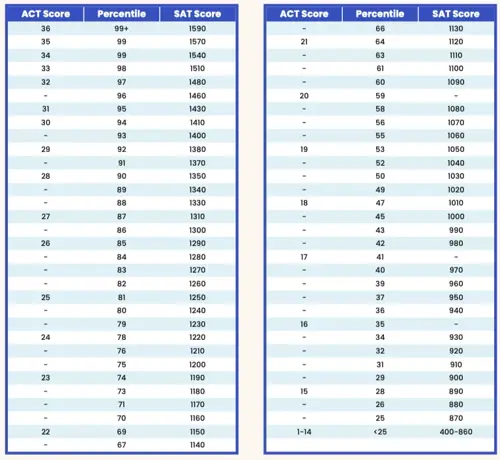
Here's the latest concordance table.